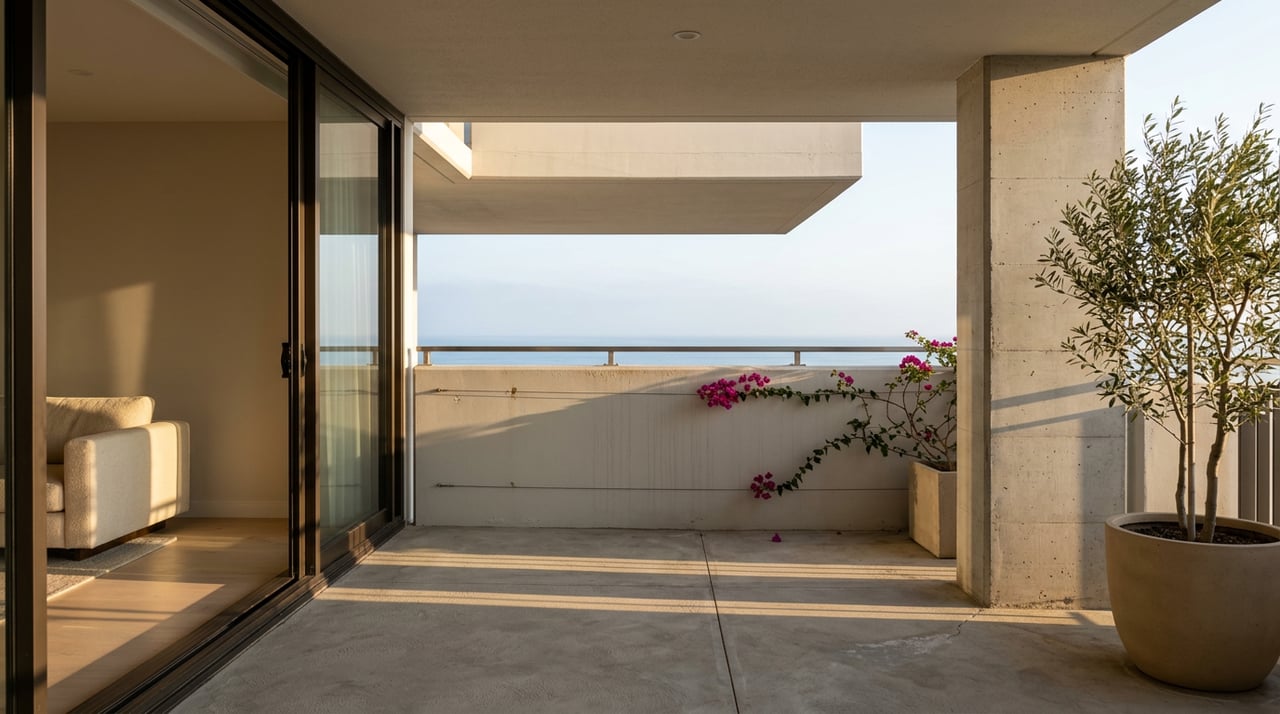
Every escrow file for an older California condominium now carries the same question: is there a report showing the building's balconies passed a structural inspection, and if there isn't one, does that missing report stall the deal. Buyers' agents statewide started asking it in earnest this year, after a new law called Senate Bill 410 took effect on January 1, 2026, and folded that inspection report directly into the paperwork every condo seller has to hand over.
At Coronado Shores, that question is aimed at the wrong document.
The ten towers that make up the Shores, from Cabrillo at the north end to La Princesa, went up as steel-and-concrete construction between 1970 and 1978. That is not the building type the balcony law was written to catch. It does not mean a Shores seller has nothing to disclose. It means the disclosure conversation starts from a different question than the one making the rounds on every other California condo listing right now, and a fair number of owners here have not asked their building's board that question yet.
What SB 410 Actually Changed on January 1
The underlying inspection mandate, Senate Bill 326, has been law since 2019. It required California homeowners associations with three or more units to inspect their exterior elevated elements, meaning balconies, decks, walkways and stairways, with the first inspection due by January 1, 2025. What changed this year is what happens to that report once it exists.
Senate Bill 410, sponsored by the California Association of Realtors and effective January 1, 2026, amended Civil Code section 4525 so the most recent SB 326 inspection report now has to be included in the disclosure packet a seller delivers to a prospective buyer before that buyer removes contingencies. The same law shortened how long an association has to hand over records when a member requests them in writing: ten business days for current fiscal year documents, thirty calendar days for the prior two years. For a seller trying to assemble a clean file quickly, that production window matters more than the headline law itself.
There is also a piece of confusion worth clearing up before it costs anyone time. A separate bill, AB 2579, gave apartment buildings under the companion law SB 721 an extra year to complete their first inspection. Several 2026 legal updates have had to walk back articles claiming that same extension applies to condo associations. It does not. The SB 326 deadline for HOAs was January 1, 2025, full stop, and it was never moved.
The Wood Trigger Nobody Reads Past the Headline
Here is the part of SB 326 that gets skipped in most of the coverage: the inspection requirement only attaches to exterior elevated elements that are supported substantially by wood or wood-based products, more than six feet above the ground. A ground-floor patio does not count. A steel-and-concrete cantilevered slab does not count either, unless the decking, guardrail, or waterproofing assembly layered on top of it is wood-framed.
That is the exact construction question a Coronado Shores seller needs answered, tower by tower, before assuming either extreme. Assuming the law does not apply because the building is concrete is not a safe shortcut. Assuming it does apply because every other listing agent is asking about it is not a safe default either. The only accurate answer is whatever each tower's own board has determined and put in writing, and as of this year that determination, or the documented absence of one, belongs in the seller's disclosure file regardless of which way it comes out.
Ten Towers, Ten Separate Paper Trails
The detail that makes this more than a legal technicality is how Coronado Shores is actually governed. Each of the ten towers is its own incorporated condominium association, with its own board, budget, and reserve study. There is no single Coronado Shores HOA to call for a blanket answer. A clean disclosure file at one tower says nothing about the tower next door.
That decentralization shows up in the association's own records. The Landscape and Recreation Committee, the joint body that manages the shared grounds and amenities across all ten buildings, met in June 2025 to work through hiring a reserve-study consultant, and the minutes show just how separately each tower's leadership operates. Building 8's representative was ready to move ahead on inspection work already under discussion. Building 9's representative asked to delay a vote because the board had recently turned over and needed more time. Building 10's representative went further, arguing the joint committee did not have the authority to commit association funds without bringing the full membership in first. Three buildings, three different postures, in the same meeting.
El Mirador, Coronado Shores Condominium Association No. 9, has its own documented history to match: a special assessment for plumbing repairs on record from 2017, and a separate special assessment meeting held on June 10, 2024. None of that appears in any other tower's file. It is El Mirador's alone.
A sample of what is already a matter of record across a few of the towers:
| Tower | Association | Built | On the record |
|---|---|---|---|
| Cabrillo | No. 1 | Construction began 1970, first tower completed | Original tower of the community |
| La Sierra | No. 2 | 1973 | Major common-area upgrade completed since 2007, including elevators and balcony railings |
| El Camino | No. 5 | 1970s | Own separately governed HOA and budget |
| El Mirador | No. 9 | 1970s | 2017 special assessment for plumbing; June 2024 special assessment meeting |
The Coronado Shores community as a whole was built out in stages between 1970 and 1978, according to the Coronado Historical Association. Fifty years of separate ownership since then means fifty years of separate maintenance decisions, and now, under SB 410, fifty years of separate paperwork a seller has to be ready to produce on request.
The Real Disclosure Homework
Regardless of how the wood-frame question shakes out for a given tower, Civil Code section 4525 already required sellers to hand over governing documents, current and prior budgets, the reserve study, insurance declarations, recent board minutes, and any pending special assessments or litigation. SB 410 did not replace that list. It added one more line item to it and tightened the clock on how fast an association has to respond when someone asks.
Before listing a Coronado Shores unit in 2026, it is worth putting these questions to the tower's board directly, in writing, rather than waiting for a buyer's agent to raise them during escrow:
- Has this building's board made a formal determination on whether its balconies, railings, or decking are supported by wood-based materials under SB 326, and is that determination documented anywhere a buyer can review it?
- What is the reserve study's most recent completion date, and what percentage of the recommended reserve is currently funded?
- Have any special assessments been approved, proposed, or discussed in board minutes over the past two years?
- Has the association tested its own ability to meet the new ten-business-day window for producing current-year records on request?
A board that can answer all four before a listing goes live saves a buyer's agent from having to chase them down later, and saves the seller from a delay that has nothing to do with the condition of the unit itself.
FAQ
Does SB 326 apply to Coronado Shores condos? It depends on the individual tower. The inspection mandate only reaches exterior elevated elements supported substantially by wood, and the Shores towers were built as steel-and-concrete structures. Whether a given balcony assembly still qualifies is a determination each building's board has to make and document, not something a seller or agent should assume either way.
What if my tower's board has never addressed this? Ask in writing before listing. Under SB 410, an association has to produce current fiscal year records within ten business days of a written request, so there is no reason to let a buyer's agent surface this question for the first time in escrow.
Does this change anything for a sale already moving through escrow right now? SB 410 took effect January 1, 2026, and the requirement attaches to when disclosures are delivered, not when a listing first went live. Any Coronado Shores transaction assembling its disclosure packet now falls under the new rule.
How is this different from a typical single-building condo? In most condo complexes, one HOA covers the whole property, so one packet answers every reserve and assessment question. At Coronado Shores, each of the ten towers, Cabrillo through La Princesa, is a separate legal association with its own board and budget. A clean file at one tower says nothing about the next one down the beach.
Getting ahead of this paperwork before a listing goes live is exactly the kind of groundwork that keeps a Coronado Shores sale on schedule. If you own a unit in one of the towers and want a clear read on what your specific building's file looks like, The Morabito Group can walk through it with you, tower by tower, starting with a personalized Coronado market consultation.